
Can I create demand?
That is the question Meta Ads answers, and it is a different question from the one Google Search answers. Nobody opens Instagram to buy a heat pump. They open it to see what their cousin is doing on holiday, and somewhere between the third and fourth post they see yours. That is interruption, not intent: you are paying to put something in front of a person who was not looking for it, did not ask for it, and can scroll past it in a third of a second.
That is Meta's weakness and its entire point in the same sentence. Someone typing "emergency plumber Wellington" into Google has already decided; a plumber will almost always get a cheaper enquiry there, and no amount of clever Meta targeting changes that. Meta earns its place at the other end, where the audience is defined by who people are and what they like rather than what they typed, and where the demand does not exist yet because the person does not yet know they have a problem. A new product, a category nobody searches for by name, a service people think about once every five years: those are Meta's jobs. What Meta Ads is not is a cheaper version of search, so if people are already searching for what you sell, go and meet them there first.
Google catches demand that already exists. Meta creates demand that does not. Most businesses need both, and most need them in that order.
How an ad finds someone
Three stages, and the surprising part is how little of it you touch. You hand Meta a piece of creative and a budget; Meta decides who actually sees it. Understanding that division of labour is most of what separates someone who fixes the right thing from someone who keeps rebuilding audiences.
You supply
Your creative
the image or video, the headline, the offer
Meta decides
The auction and the algorithm
shows it to people it predicts will act, learning from who responds
Where it lands
Where it shows
Facebook feed, Instagram feed, Reels, Stories
What you control
The creative, the budget, the objective, and roughly who: a country, an age range, sometimes an interest.
What Meta controls
Exactly who sees it, at what moment, and on which placement. You are handing over the steering wheel and keeping the destination.
Here is the consequence, and it is the sentence worth keeping: on Meta the creative is the targeting. The algorithm has no idea who your customer is when the ad goes live. It shows the creative to a spread of people, watches who stops scrolling and who acts, and narrows toward more people like them. An advert built around a tradesperson's ute finds tradespeople; the same offer photographed on a kitchen bench finds homeowners. Changing the picture moves the audience more reliably than changing the audience settings does, which is why experienced buyers spend their time in the creative and their competitors spend it in the targeting panel.
The four numbers
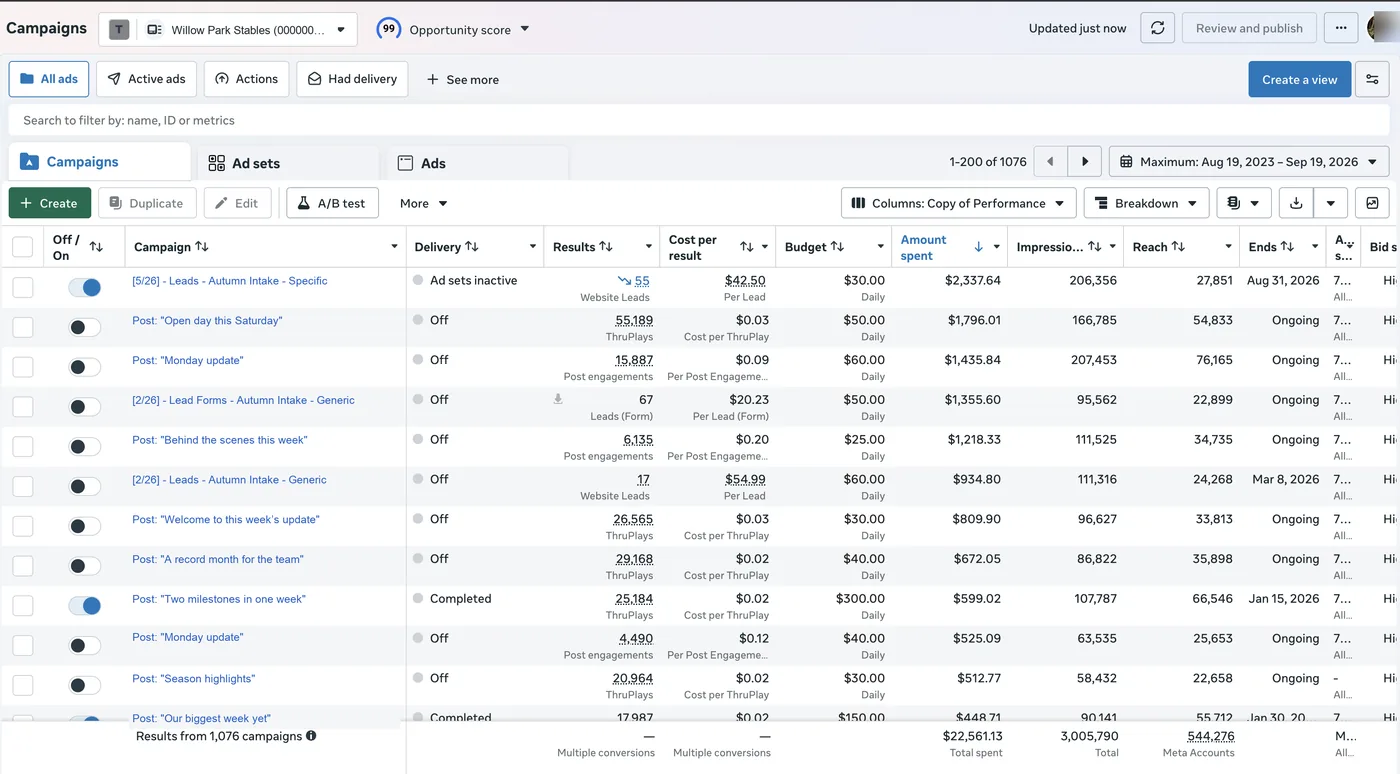
Meta's reporting has hundreds of columns and four that matter on a Monday morning. Each one answers a question you already have. These are deliberately short here; Meta Ads metrics explained takes the same four apart properly, including why you read them as a chain rather than a list.
What am I paying to be seen?
CPM: the price of a thousand impressions. It moves with competition, season and how much Meta likes your creative.
At a NZ$18 CPM, a NZ$1,200 month buys roughly 67,000 impressions.Ads Manager · Performance columnsIs the creative working?
CTR: clicks divided by impressions. The one number that judges the picture, the headline and the offer together, before your website gets involved.
A 1.2% CTR is 12 clicks for every 1,000 times the ad was shown.Ads Manager · by adHow many times is the same person seeing it?
Frequency: impressions divided by reach. The number unique to this platform, and the earliest warning that a creative is wearing out.
A frequency of 2.4 over a month is comfortable. The same figure over a week is not.Ads Manager · Delivery columnsWhat did a result cost?
Cost per result: spend divided by results, where the result is whichever outcome your objective named.
NZ$32 per purchase is a number you can hold against your margin.Ads Manager · Results columnRead in that order they tell a story rather than four separate facts. A cost per result that has drifted upward has only a few possible causes, and the three numbers above it name which: you are paying more to be seen, or fewer people are clicking, or the same people are being shown the same thing too often. The fix is different in each case, and guessing between them is how budgets get raised on a problem more money makes worse.
The creative is the targeting. Change the picture and you change the audience, faster than any setting in the targeting panel.
Setting it up
Five steps, about seventy-five minutes, and the order matters more than the speed. Steps one and two are the ones people skip and regret.
- 1Create the Business Manager and the ad account properly
Set up a Business Manager owned by your own Google or email login, then create the ad account inside it. If an agency creates it in theirs, you are renting your own advertising history. Add the agency as a partner instead; you keep the assets when the relationship ends.
15 min - 2Install the Pixel and the Conversions API
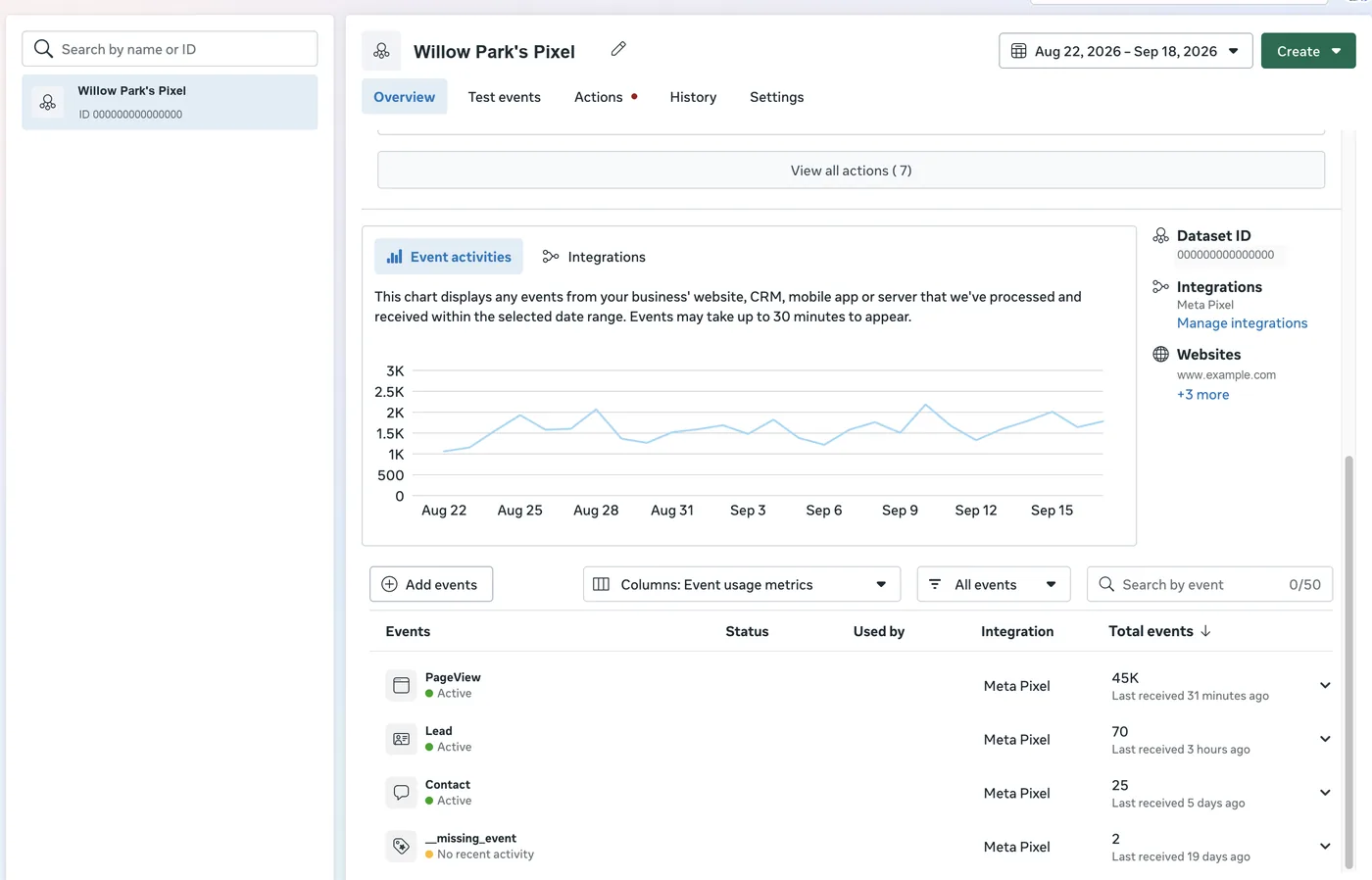
The Meta Pixel goes on your website; the Conversions API sends the same events from your server. Both, not one: browser privacy controls now hide a large share of conversions from the Pixel alone, and an algorithm optimising on half the results learns half as well.
20 min - 3Pick one objective, and make it the real outcome
The objective is what the algorithm optimises toward, so choose the thing your business actually wants. Ask for traffic and you will get people who click and leave, cheaply and in quantity. Ask for purchases and you will pay more per click and more per person, and get orders.
5 min - 4Build one campaign with two or three genuinely different creatives
Different, not three colours of the same thing: a customer video, a product still, a plain offer card. You are giving the algorithm room to find which kind of person responds to which kind of message. Three variations of one idea test nothing except the variations.
30 min - 5Set a budget that can produce enough results to learn from
Meta needs volume to optimise. Aim for at least 15 to 25 results a month: if your target cost per result is NZ$40, that is NZ$600 to NZ$1,000 of budget. Below that the algorithm never finishes learning and you are paying for noise you will then read as a verdict.
5 min
Three things beginners misread
The wrong read
"Meta claims 48 purchases, Analytics shows 19. Meta is making it up."
The right read
"Meta counts people who saw the ad and later bought. Analytics credits whatever sent the final visit. Both are counting honestly, and neither is the whole picture."
Misread one
Meta and Analytics will never agree
Meta counts a conversion when someone who saw an ad converts inside its attribution window, and that includes people who never clicked. Google Analytics credits the last channel that sent the visit, so the same person who saw a Meta ad on Tuesday and typed your name into Google on Friday is a Meta purchase to Meta and an organic visit to Analytics.
Expect Meta to report more, always. The useful habit is to pick one number for decisions and stick to it, usually the one from your own orders or enquiries, and read the platform figures as direction rather than as a count.
The wrong read
"Frequency is up to 4.1 and clicks are down. The audience is too small, so let's raise the budget."
The right read
"The same people have now seen this ad four times and stopped noticing it. A new creative resets it; a bigger budget just shows the tired one more often."
Misread two
Rising frequency with falling CTR is fatigue
When frequency climbs and click-through falls at the same time, the ad is wearing out. Everyone in the pool who was going to respond has responded, and Meta is re-serving them because it has nothing fresher to show. CPM usually rises alongside, because the platform charges more to keep reaching the same people.
More budget accelerates this rather than fixing it. The fix is a new creative, and our creative performance loop is the whole method: how many concepts to run, when to refresh, and how to keep a queue so the replacement is ready before the numbers demand it.
The wrong read
"It is not working yet, so I paused it on Thursday, changed the audience, and turned it back on."
The right read
"That restarted the learning phase. The four days of data Meta had already paid to collect are gone, and the next four will be spent collecting them again."
Misread three
Fiddling resets the learning
A new or edited ad set enters the learning phase, where Meta is still working out who responds and costs run high and erratic. Significant edits (the budget, the audience, the objective, the creative) restart it. So does turning a campaign off and on again.
The discipline is boring and it pays: leave a new campaign alone for a week, or until it has produced enough results to say something. Judge it then. Restless editing every few days means you are permanently buying the most expensive phase of the campaign and never reaching the cheap part on the other side.
In Clearly
Meta Ads connects today. Sign in with the Facebook account that has access to your ad account, pick the account, and the report fills with your campaign performance: spend, impressions, reach, frequency, CTR, CPM, results and cost per result, each against the previous period and each coloured by whether that move is good or bad for that particular metric, so a falling CPM reads green and a falling CTR reads red.
Two blocks are worth building a report around. The top ads block renders the actual ad as it ran, the image or the video thumbnail, with its spend and cost per result beside it, so the conversation with a client or a colleague starts from what people saw rather than from a row of campaign names nobody recognises. The creative fatigue block reads frequency, click-through and CPM together on each creative, because any one of them moving has an innocent explanation and all three moving together is the diagnosis, and tells you which creatives are wearing out while there is still time to line up the replacement.
Meta metric cheat sheet
| Metric | What it is | How it is counted |
|---|---|---|
| Impressions | How many times your ad was shown | Every appearance counts, so one person can generate many |
| Reach | How many separate people saw it | Each person counted once for the period, however often they saw it |
| Frequency | Average times each person saw it | Impressions divided by reach, for the period you selected |
| Clicks | Taps on your ad | Link clicks go to your website; all clicks include likes and expands |
| CTR | Click-through rate | Clicks divided by impressions, as a percentage, never an average of daily rates |
| CPM | Cost per thousand impressions | Spend divided by impressions, times one thousand |
| Cost per result | What one outcome cost you | Spend divided by results, where the result is whatever your objective named |
| ROAS | Return on ad spend | Revenue divided by spend, from summed totals rather than averaged campaign figures |
Common questions
How much do I need to spend to test Meta properly?
Enough to produce 15 to 25 results a month, which is the volume the algorithm needs before it stops guessing. Work backwards from your target cost per result: at NZ$40 a lead that is NZ$600 to NZ$1,000 a month, and you want two or three months of it before you judge anything. Spending NZ$200 for three weeks does not give you a small answer, it gives you noise that looks like an answer.
Why does Meta report more conversions than Google Analytics?
They count different things. Meta credits an ad when someone who saw it converts within its attribution window, including people who never clicked. Analytics credits the last channel that sent the visit, so a person who saw your ad on Tuesday and searched for you on Friday is a Meta purchase in Ads Manager and an organic visit in Analytics. Neither is lying. Pick one source for decisions, usually your own orders, and read the rest as direction.
Do I need a Facebook page to run Instagram ads?
Yes. Every ad runs from a page, even one that only ever appears on Instagram, and linking the Instagram account to the page is part of setup. While you are there, the page is worth running for its own sake: it costs nothing, it is the first thing a curious buyer checks, and it has its own numbers worth reading. That is the next guide in this series, Facebook and Instagram Pages for Beginners.
How often should I change my creative?
When the numbers say so rather than on a calendar. Rising frequency with falling click-through, usually alongside a rising CPM, is the signal, and it arrives sooner for a small audience than a large one. The practical habit is to keep the next concept ready before you need it, which is what the creative performance loop is for.
Should I boost a post or build a campaign?
Boost for reach on something already doing well organically, and expect engagement rather than sales. Build a campaign in Ads Manager for anything you want a business outcome from, because that is where the objective, the placements and the conversion tracking live. A boost optimises for people who will react to a post, which is not the same audience as people who will buy.
Where to go next
Get the Pixel and the Conversions API in place before you spend anything, because everything after that depends on Meta seeing what happened. Then put one budget behind two or three genuinely different creatives, leave it alone for a week, and read the four numbers in order: what you paid to be seen, who clicked, how often the same person saw it, and what a result cost. Almost every decision in the first six months is one of those four moving.
The series
All nine Platform 101s, in setup order
What each platform does, what it costs, how to set it up, and what its numbers mean.